

- Stablecoins as the Base Pair of Crypto Trading
- Liquidity Is Execution: Why Stablecoins Drive Market Depth
- Instant Settlement and Capital Efficiency
- DeFi, Leverage, and Stablecoins as Collateral
- Bitcoin vs Stablecoins: Store of Value vs Execution Layer
- Why Stablecoins Are Becoming the Real "Money" of Crypto
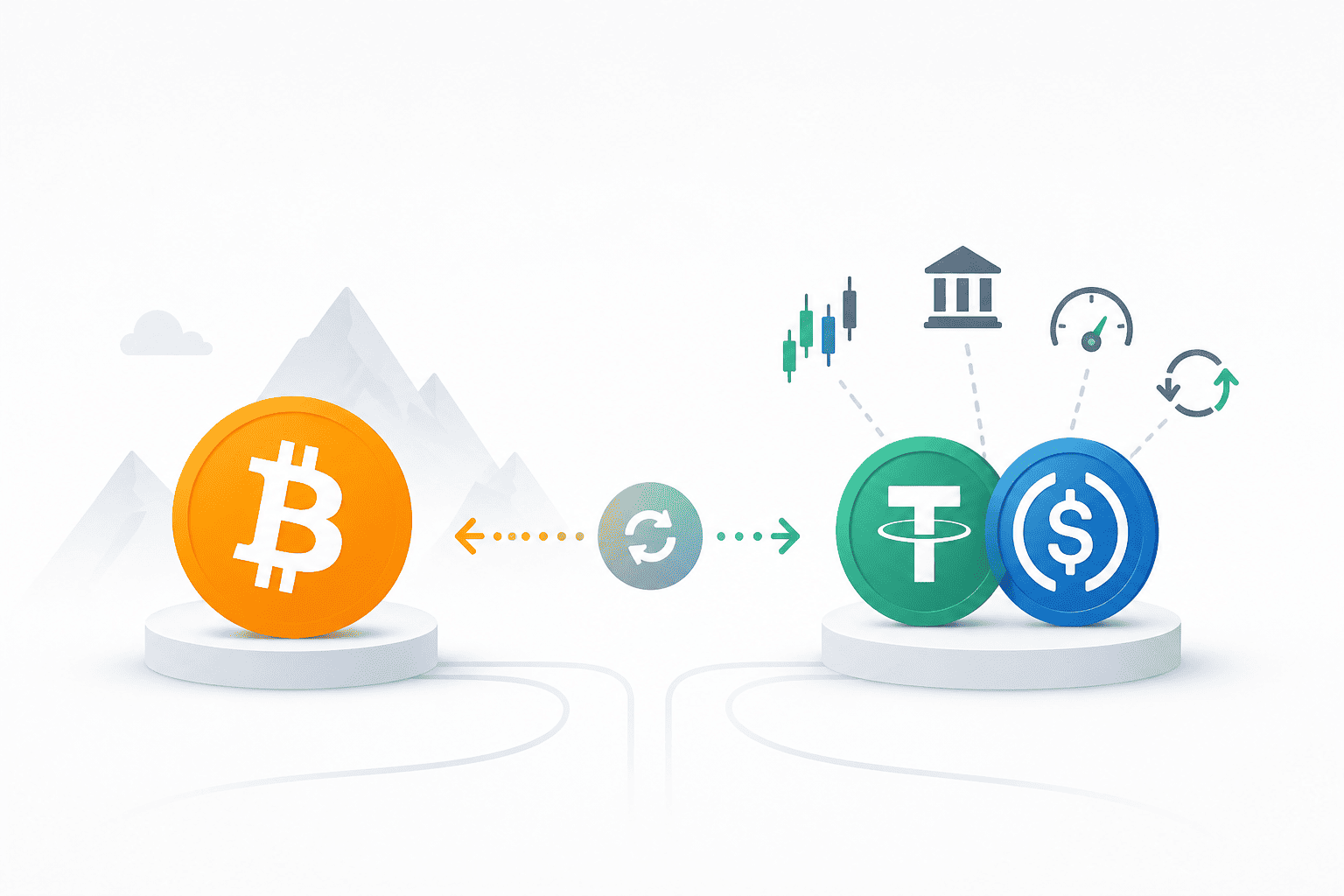
Bitcoin is still the biggest topic in the world of crypto, and it's the most talked about. However,
when it comes to day-to-day trading, the heavy lifting is done by stablecoins rather than Bitcoin.
Crypto markets don't run on narratives and public engagement, but on execution rails, and
those are now mostly based on stablecoins.
On most exchanges, the trading flows through pairs such as BTC/USDT or ETH/USDC. These
pairs determine how quickly capital moves and how users can access liquidity.
Stablecoins as the Base Pair of Crypto Trading
The dominant quote currency isn't fiat in almost any order book; instead, it's stablecoin. USDT,
USDC, and increasingly other dollar-pegged assets serve as the base layer for pricing risk.
This matters more than the average user may realize.
In traditional markets, traders rely on fiat accounts and banking rails to move capital between
positions. According to experts such as those at CCN, stablecoins can be used to do so without
the friction. The users are therefore not converting to dollars directly, but only buying and
selling within the crypto system.
Such a practice simplifies the trading process. Risk is measured against a consistent unit, and
execution is faster. P&L is tracked in stable terms. Stablecoins are, therefore, a key part of the
trading infrastructure.
Liquidity Is Execution: Why Stablecoins Drive Market Depth
Liquidity is essential for fast and stable transfers. To maintain liquidity, the exchange needs
enough funds on hand to process transfers. This is where stablecoins come in. The deepest
order books, tightest spreads, and most active market-making strategies all sit around
stablecoin pairs.
This means there's a link between stablecoin supply and trading conditions. If stablecoin
liquidity increases, slippage decreases, and spreads tighten. At the same time, if liquidity drops,
trade execution worsens.
For traders, this shows up in subtle ways, but it's costly. Entries get worse. Exits become
harder to time. Large orders move the market more than expected. All of these depend on how
many stablecoins are available to trade, and all end up costing users.
Instant Settlement and Capital Efficiency
In traditional finance, capital is almost always tied up in institutions, and transferring it from one
to another takes time, energy, and labor, making it costly. In crypto, those transfers are made
instantly and don't depend on the business hours of any institution.
This has an impact on capital efficiency. A trader can use stablecoins to run efficient trading
strategies. recycle margin faster, and react to volatility without delay. If Bitcoin had been used
as a base, the coin's volatility would have made it impossible.
DeFi, Leverage, and Stablecoins as Collateral
The same dynamic plays out even more clearly in DeFi. Stablecoins are also used as a
backbone of this market, liquidity pools, and leveraged positions. Those who borrow to go long
use stablecoins, and so do the traders who farm yields.
The stablecoins have therefore become a unit of account across the trading ecosystem. Such a
role is possible because it sits between traditional finance and crypto markets. When
stablecoins were first introduced, no one imagined this role.
Bitcoin vs Stablecoins: Store of Value vs Execution Layer
However, the use of stablecoins doesn't diminish Bitcoin's use. In fact, it reframes it and
enhances it. Bitcoin has proven to be the best crypto to store value because, in the long run, its
value has changed but remained stable and evened out even after downturns.
Volatility is the key problem, as Bitcoin's price still fluctuates in the short term. Every trade
carries additional risk if the base value can be changed. Gains and losses are harder to isolate.
Position sizing becomes less precise. The use of stablecoin as a middle layer solves this
problem.
A division of roles, therefore, takes place. Stablecoins and Bitcoin operate together with two
different roles in the system. Stablecoins become the infrastructure you use to trade everything
else. Most professional exchanges are aware of this and already use stablecoins with that goal
in mind.
Why Stablecoins Are Becoming the Real "Money" of Crypto
Cryptos have always played a somewhat risky role in the finance sector. They offer many new
benefits and advantages, but aren't recognized as money or financial assets by traditional
finance. The introduction of stablecoins has allowed traditional financial institutions to leverage
the advantages of cryptocurrencies without their volatility.
Stablecoins have also found use in the day-to-day operations of crypto exchanges. Stablecoins
are the middle layer for trading, allowing users to maintain liquidity and make transitions faster
without worrying about the volatility of one side of the trading pair. The infrastructure is the key
element of crypto trading and one that's too often overlooked. Stablecoins are used as such
infrastructure.


