

- Solana and Ethereum Follow Different Design Paths
- Speed Is Becoming an Economic Advantage
- Transaction Costs Change What Users Can Do
- Scalability Is Also a Liquidity Question
- Where the Capital Sits
- One Market, Different Constraints
- Adoption Is Moving Beyond the Old Ethereum Lead
- Stablecoins Expand the Use Case
- Security Comes With Different Trade-Offs
- Regulation Could Shift the Competitive Balance
- What Could Change the Balance
- Base case
- Optimistic case for Solana
- Stress case
- Which Network Fits Which Use Case?
- The Race Is Changing Shape
- FAQ
- 1. Is Solana faster than Ethereum?
- 2. Is Solana cheaper than Ethereum?
- 3. Which network has more developers?
- 4. Is Ethereum better for DeFi?
- 5. Is Solana better for trading?
- Disclaimer
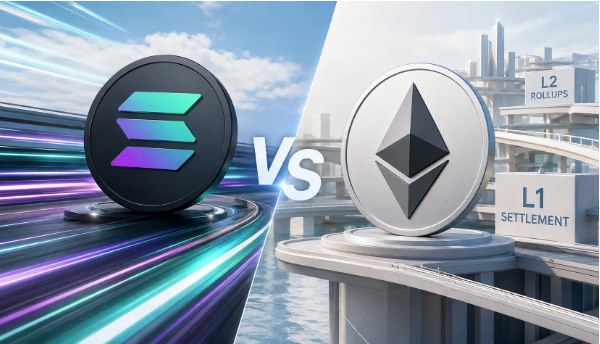
Solana is taking a larger share of on-chain activity, while Ethereum is changing how its network scales. The old speed-versus-ecosystem comparison no longer tells the whole story. Their competition is becoming a question of where users, liquidity and real economic activity end up.
Solana and Ethereum Follow Different Design Paths
The old view of Ethereum as a congested mainnet and Solana as its faster alternative is becoming dated. Ethereum has made rollups cheaper, while Solana is raising its capacity. In July 2026, Solana increased its block limit from 60 million to 100 million compute units, with Alpenglow targeting roughly 150ms finality.
The architectural divide remains. Ethereum moves more execution to Layer 2 while Mainnet handles settlement and data availability. Solana keeps applications and liquidity closer to one Layer 1. Ethereum’s rollups are now around 5 to 20 times cheaper than L1 transactions.
For users moving between ecosystems, this can be tangible. Someone converting ETH into Monero is dealing with two separate networks and their own transaction rules. ChangeNOW can abstract that infrastructure through an ETH to Monero swap, leaving the user focused on the conversion itself.
Ethereum is spreading execution across L2s. Solana is putting more capacity into its base layer. The next test is how well each model handles further growth without adding friction for users.
Speed Is Becoming an Economic Advantage
Solana’s speed matters most when milliseconds affect the outcome. DEX trading is a clear example. Market makers constantly update quotes, so delays can mean a worse execution price. Payments and other high-frequency applications face similar constraints.
Solana currently produces slots in about 400ms, with roughly 400ms pre-confirmation latency. Its Alpenglow upgrade targets around 150ms finality. Ethereum still uses 12-second slots, while full finality takes about 15 minutes. Its developers are working on single-slot finality to reduce that gap.
For an occasional transfer, these differences may barely matter. For applications processing transactions continuously, small delays can accumulate into real costs.
That is where Solana’s performance becomes economically relevant. Ethereum has a tougher performance gap to close, but faster confirmation is now part of its scaling roadmap too.
Transaction Costs Change What Users Can Do
Fees matter little when moving a large amount once. They matter much more when an application handles hundreds of small transactions.
Solana’s base fee is 5,000 lamports per signature, or 0.000005 SOL, with priority fees added when block space is in demand. Ethereum has also become cheaper, but the cost gap between Mainnet and L2s remains meaningful. Ethereum’s documentation estimates that rollups can be around 5 to 20 times cheaper than Layer 1.
Low fees change the economics of activities such as:
- small-value payments
- frequent trading or rebalancing
- in-game purchases
- stablecoin transfers
Solana’s payment documentation puts a typical transfer below $0.001 under normal conditions, although creating a new token account can add a separate one-time cost.
Ethereum can reach similarly low costs through L2s, but users may need to consider where their assets and applications are located and whether funds must move between networks. That extra friction matters for frequent activity.
Low transaction costs therefore affect more than the final fee. They determine which use cases are practical at scale and give Solana a strong position in payments, trading and other high-frequency activity.
Scalability Is Also a Liquidity Question
Where the Capital Sits
Ethereum’s L2 expansion has changed where traders find liquidity. Uniswap now operates across Ethereum Mainnet, Arbitrum, Base, Optimism and other networks, so the same token can have very different pool depth depending on where it is traded.
That is not just a technical detail. A large swap on one network may move the price more than the same trade on another. A trader may therefore check several venues before executing, especially for less liquid pairs.
Gigwise’s comparison points to a meaningful difference in where activity is concentrated. Ethereum continues to attract substantial capital into DeFi and staking, while Solana has become a stronger venue for active on-chain trading. The Ethereum vs. Solana comparison links this gap to the different ways users deploy capital across the two ecosystems, rather than treating transaction activity alone as a measure of adoption.
One Market, Different Constraints
Solana’s trading infrastructure is more concentrated. Jupiter, for instance, routes orders across Solana venues such as Raydium and Orca without making the user choose between separate L2s first.
That makes some forms of DeFi composability easier. It does not guarantee deep liquidity everywhere, though. A thin pool is still a thin pool, and a sudden surge in demand can put pressure on the same shared network.
For Ethereum, the problem is often finding the right pool across several networks. For Solana, it is making sure the liquidity already gathered in one ecosystem can handle the next wave of demand.
Adoption Is Moving Beyond the Old Ethereum Lead
Ethereum still has the larger developer ecosystem, but Solana is bringing in new builders faster. Electric Capital recorded 83% growth in Solana’s new-developer count in 2024, the highest among blockchain ecosystems that year.
Electric Capital also found that Solana accounted for 81% of DEX transactions in its 2024 data, while Ethereum remained ahead in overall developer activity. The figures point to two ecosystems attracting different kinds of participation rather than a simple shift from one chain to another.
Stablecoins Expand the Use Case
Stablecoins offer a useful test of whether network activity extends beyond trading. Artemis tracks more than $300 billion in stablecoin supply across 150-plus tokens, with roughly 60 million transactions and more than $100 billion in daily transfer volume.
Solana is gaining a share of these flows, giving its ecosystem another source of recurring activity. The longer-term question is whether stablecoin transfers and financial applications can keep that usage active when trading volumes fall.
Security Comes With Different Trade-Offs
Running an Ethereum validator requires 32 ETH plus execution and consensus client software. Ethereum also supports several client implementations, while smaller holders can participate through staking pools.
Solana has no fixed staking deposit, but its validators need more capable hardware and faster connections to handle the network’s workload.
Validator count alone says little about decentralization. More useful measures include:
- stake concentration
- infrastructure distribution
- client diversity
- barriers to independent operation
Ethereum currently has the advantage in client diversity and hardware accessibility. Solana’s model puts more weight on validator infrastructure.
Regulation Could Shift the Competitive Balance
Ethereum has a more established route into regulated investment. U.S. spot Ether ETFs began trading in July 2024, giving institutions a familiar way to gain ETH exposure without holding the asset directly.
For Solana, the regulatory path for SOL investment products has been less settled, with staking adding another issue for asset managers.
The practical hurdles are familiar:
- custody must fit the fund’s regulatory framework
- investment products need an acceptable structure
- staking can raise questions around rewards, reporting and compliance
Clearer rules for SOL products and staking could therefore change institutional demand without requiring a major technical shift from Solana.
What Could Change the Balance
The next shift may come from activity outside core crypto trading. Tokenized securities, stablecoin settlement and regulated investment products could create demand that is less dependent on retail speculation.
Base case
Ethereum keeps its institutional advantage while Solana expands into newer financial applications. The gap narrows, but neither ecosystem displaces the other.
Optimistic case for Solana
Sustained growth in tokenized assets and stablecoin settlement would give Solana a broader adoption base and make SOL demand less tied to DEX activity.
Stress case
A prolonged downturn could expose Solana’s greater sensitivity to trading activity. Ethereum’s broader economic base may prove more resilient.
Base and Arbitrum can also absorb activity while keeping users within the Ethereum ecosystem. Sui and Aptos are competing for applications that need high throughput. The more important measure over time may be whether these networks retain capital and users after market conditions turn less favorable.
Which Network Fits Which Use Case?
The practical choice depends on what the user is actually doing.
- Active trading: Solana suits frequent on-chain trading, while Ethereum remains attractive for users already working across established DeFi protocols and L2s.
- Long-term holding: Ethereum has more mature staking, custody and investment infrastructure. Solana offers exposure to a younger ecosystem built around trading and newer applications.
- Payments: Solana works well where both sides already support the network. Ethereum L2s can offer similar costs, but moving assets between networks may add an extra step.
- Cross-network activity: Ethereum provides more routes through its wider L2 ecosystem, although users need to track where assets and applications are deployed.
The useful distinction is therefore less about choosing a permanent winner and more about matching the network to the task.
The Race Is Changing Shape
Ethereum spent years building a lead around developers, capital and applications. Solana challenged it by pulling activity toward a faster, high-throughput network. The old “ecosystem versus speed” comparison no longer explains the gap.
The next market cycle will be more revealing. Ethereum needs its L2 ecosystem to feel coherent, while Solana must prove its momentum can survive weaker trading conditions. The real question is which network can keep users and capital once the easy growth is gone.
FAQ
1. Is Solana faster than Ethereum?
Yes. The difference is most noticeable in frequent, transaction-heavy activity.
2. Is Solana cheaper than Ethereum?
Usually for direct transactions. Ethereum L2s can also offer very low fees.
3. Which network has more developers?
Ethereum still has more developers overall, while Solana has been adding new ones faster.
4. Is Ethereum better for DeFi?
Ethereum remains stronger in established DeFi, with deeper protocols, liquidity and infrastructure.
5. Is Solana better for trading?
It has a strong advantage in frequent on-chain trading thanks to fast processing and concentrated liquidity.
Disclaimer
This article is for informational purposes only and does not constitute financial, investment, or trading advice. Cryptocurrency markets are volatile, and network conditions, fees, regulations, and technology can change quickly. Readers should conduct their own research and consider their individual circumstances before making any decisions involving digital assets.


