

- Why enterprise wallet security is different from personal wallet security
- Private key protection is still the foundation
- MPC is changing how enterprises manage signing authority
- Hardware security remains an important layer
- Access control is becoming as important as key security
- Policy engines are adding rules before transactions are signed
- Multi-level approvals reduce single-user risk
- Address whitelisting can reduce transaction errors
- Real-time monitoring is becoming part of wallet security
- Auditability is a core enterprise requirement
- Enterprise wallets need business continuity planning
- AI and automated risk detection are entering wallet security
- What a modern enterprise wallet security stack looks like
- Enterprise wallet security checklist for 2026
- What comes next for enterprise wallet security?
- Final thoughts

The advice "protect the private key" still appears in security guides as an answer to this question. If you're the only person managing your own money, then it does. For a company where a finance analyst needs to see balances, a treasury manager needs to send payments, a CFO needs to sign off on large transfers, and an IT admin needs to manage infrastructure without ever touching the money, one protected key answers one question and leaves ten others open.
In 2026, enterprise wallet security will be built in layers: key protection at the bottom, access controls above it, transaction policies above those, and monitoring running across all of them. Each layer deals with a different type of risk that the layer below doesn't cover. If you skip one, the gap will stay open, even if everything else is solid.
Why enterprise wallet security is different from personal wallet security
A personal wallet has one owner who can decide when money moves. Security means making sure only one person can get into something. If the seed phrase is safe, the funds are safe. The setup is simple because the structure is simple.
An enterprise wallet is useful for teams because different people can use it for different things. A finance analyst needs to read transaction history but shouldn't be able to send anything. A treasury manager's job is to make regular payments, but they should not be approving their own transfers. A CFO is in charge of approving large amounts of money, but they don't get involved in the day-to-day running of the business. An auditor can read the file, but cannot change anything. If you share one admin account, these limits won't apply.
Business security also has to deal with staff changes. When someone leaves, their access has to go with them – but the company still needs to reach its own funds. If you rely on one person knowing the master password, the whole system is at risk as soon as that person leaves. In a company, "gone" can mean different things. It can mean sick leave, resignation, or a security breach. That's not an unusual situation. It's a Tuesday.
Private key protection is still the foundation
The private key controls the funds. Whoever holds it can sign transactions, and once signed, blockchain transactions can't be undone. This hasn't changed. What has changed is how companies think about key exposure.
The real risks aren't clever attacks. A private key is saved to a shared drive because "it's easier to reach". A seed phrase is a set of words that is photographed during setup and kept in your camera roll. If you lose a laptop backup file, that's bad news. These are all normal decisions that can weaken a security measure.
Modern business key security is based on the idea that no one person, device, or system should be able to control the signing material. The tools that handle this – MPC, HSMs, distributed key management – each work differently, but none help if the key backup sits on a Post-it note in the server room.
MPC is changing how enterprises manage signing authority
Multi-Party Computation (MPC) is a way of signing something that involves several parties, so no single person or organisation ever has complete control of the private key. Instead of one key that signs a transaction, MPC produces a result from several key pieces held by different parties – and all pieces are needed. If someone steals one device, they get one piece – and one piece moves nothing.
Imagine a company that uses MPC. In this case, two out of three key holders must agree to the transfer before it can be made. The treasury manager has one piece of information on their device, one on a secure server, and one with a backup holder. If the treasury manager's laptop is stolen, the thief has nothing and can't move any money.
MPC also makes transaction rules more flexible. For transfers under $50,000, you can require two out of three signatures. For anything above this amount, you will need three out of three signatures. You don't need to create a new wallet for each limit. The main structure stays the same, but the rules change a little.
Hardware security remains an important layer
Hardware Security Modules (HSMs) keep your most important data locked in a case that cannot be opened without permission. The signing happens inside the hardware; what comes out is the signed transaction, not the key. If someone tries to access the software side, they won't find anything useful.
When hardware alone isn't enough: an HSM that any admin can access with a shared password is more secure than a software wallet, but it still has a single access point. The hardware keeps the key safe; it doesn't decide who can ask the hardware to use it. Strong login controls and software rules matter.
In 2026, the most common setup will combine hardware-backed key storage with MPC-style distributed signing and software-enforced access rules. None of these alone covers every threat. They work well together and help each other when one is not around.
Access control is becoming as important as key security
The most important question is whether a transaction can be signed. Access control is about deciding who can request a signature. Companies that focus only on the first question don't think about the second.
Role-Based Access Control (RBAC) links permissions to job functions, not people. The "Viewer" role lets you see a record of past transactions. The "initiator" role can start transactions, but cannot approve them. In the system, the "approver" role can approve transfers, but cannot create them. A developer who updates wallet software won't be able to see the balance of the fund. When a person's role changes, their permissions also change. They don't make things more difficult for people who no longer need them.
As enterprise wallets reach larger finance and operations teams, companies need to control not only how transactions are signed but also who can start, review, and approve them. Cryptobanco is a crypto payments infrastructure built for business – treasury management, global payouts, and the access controls that teams working across borders actually need.
Policy engines are adding rules before transactions are signed
Access controls decide who can start a transaction. Before the signing stage, policy engines decide if that transaction is allowed. The two systems work together: access controls check who is trying to access something, and policy engines check how people behave.
Picture this: someone on the finance team tries to send $200,000 to a new supplier at 11 p.m. on a Friday. The policy engine blocks it because the amount is above the single-approval limit, the address isn't on the approved list, and the time is outside business hours. No one had to catch it manually.
This means that most routine mistakes and many attempts to manipulate the system are stopped by policy before anyone has to make a call. Humans are still involved, but they're not the only ones.
Multi-level approvals reduce single-user risk
If someone can both create and approve their own transfers, it shows that they have no control over their finances. It doesn't have to be on purpose – even an honest mistake or a hacked account is enough. Segregation of duties means that the person who starts a transfer and the person who approves it are always different.
For example, imagine a treasury manager who sends $500,000. The system won't process it without a second sign-off from the CFO. The CFO gets an alert, looks at the details, and either says yes or no to the request. The manager can't complete the transfer by themselves, no matter what access they have.
The only problem is that some transfers take longer. If your company deals with a lot of digital information, it's usually best to take things slowly. The other option is faster transfers, with no wait time between "sent" and "gone".
Address whitelisting can reduce transaction errors
An allowlist is a list of approved addresses that you can send money to. If you want to transfer large sums of money to a new address, you need to go through a separate approval process. This usually requires the approval of a senior member of the company and sometimes you have to wait.
Imagine this: an accountant copies a supplier's wallet address to make a payment. Malware has secretly swapped it for an attacker's address. When the accountant pastes it into the transfer field, the system flags that the address isn't on the approved list and blocks the transfer before it can be sent anywhere.
Allowlisting isn't suitable for every situation. Companies that regularly pay new partners need a fast, usable process. The right balance is to allow list high-value destinations and add extra checks for new addresses, while allowing more room for small routine payments within set limits.
Real-time monitoring is becoming part of wallet security
Prevention stops what it expects. Monitoring can spot what it doesn't–and early enough to fix it before it becomes permanent.
For example, a user logs in from a location they've never used before, at 3 am. An alert sounds. The security team checks and finds that the credentials were stolen in a phishing attack two days earlier. The attacker hasn't moved any funds yet, because the account didn't have single-user approval rights. We needed to monitor and control access.
Good monitoring covers more than blocked access attempts. It also covers unusual transfer sizes, new payout addresses added outside business hours, permission changes, failed logins on high-level accounts, and unplanned admin actions. These aren't necessarily attacks, but it's worth checking each one before the next transfer runs.
Auditability is a core enterprise requirement
A blockchain records a transfer. It doesn't record who started it, who approved it, what policy checked it, or whose login was used. The company maintains this record, called the audit log.
If there's a problem with a transfer, send it to the compliance team. Without an audit log, it's hard to say who approved something and why, because employees might not remember. With a full log, you can answer these questions in three clicks: who started it, when, who approved it, what policy was involved, and every action on that transfer from start to finish.
Audit logs also enable access reviews. If each action is linked to a person's identity, a security team can check each quarter to make sure that each person's access matches their role. They can also take back permissions that have built up over time without being used.
Enterprise wallets need business continuity planning
What happens when the person who holds a key piece goes on emergency leave? What happens when a device stops working during a transfer? What happens when an IT admin who managed wallet infrastructure leaves their job, and their accounts need to be cut off without locking the company out of its own funds?
Imagine that the person in charge of a company's money is unavailable during a crucial financial decision. If you write down and test the backup steps in advance, a second authorised person can carry out the operation. If they are not, it waits. In the world of crypto, "waits" can mean missing a chance to make a payment, which can end up costing you real money.
Just like main credentials, backup credentials need protection because they grant the same level of access. An untested backup isn't a backup. It's just a guess.
AI and automated risk detection are entering wallet security
Automated systems can spot patterns in a person's transfer history that a person checking individual payments would miss. For example, they might spot a series of transfers that each stay under the approval limit but together add up to an unusual weekly outflow. Or they might spot login behaviour that doesn't match the user's normal hours.
The real role of automated detection in 2026 is to add to predefined rules, not replace them. A policy engine that blocks transfers to unlisted addresses works fine without AI. Automated detection helps when rules can't catch certain patterns, and it reduces the number of alerts security teams must check manually.
The real problem is that the system sometimes makes the wrong decisions. Paying a large amount of money to a new supplier looks unusual, and it's usually exactly what it seems. If the automated detection fires too often, the teams will ignore it. The idea is to create alerts clear enough to check without adding noise that hides the real ones.
What a modern enterprise wallet security stack looks like
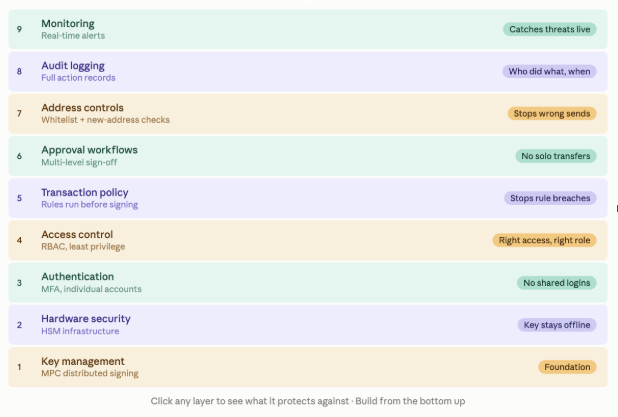
No single tool covers everything. The stack is layers, each handling a type of risk the others miss:
“Enterprise wallet security layers as of 2026. A gap in any one layer creates exposure regardless of how solid the others are.”
Enterprise wallet security checklist for 2026
Use this to review wallet infrastructure or check an existing setup. Each item that's missing is an open gap:
- Keys are protected through MPC or hardware-backed custody, so no single person has full signing authority.
- Multi-factor authentication is used on every account that can view balances, start transfers, or change settings.
- Individual logins are used, with no shared accounts or shared admin passwords.
- Each role has only the permissions it needs to do its job.
- There is a clear split between viewing, starting, approving, and managing.
- The person who creates a transfer cannot also be the sole approver.
- Transfer limits and approval thresholds match the risk level of each transfer type.
- A policy engine with rules that run before transfers reach the signing stage.
- An approved address list for high-value destinations, with a verified process for adding new ones.
- Real-time alerts on unusual logins, permission changes, and odd transfer patterns.
- Full audit logs cover transfer creation, approvals, policy checks, and admin actions.
- Regular access reviews remove permissions that are no longer needed.
- Tested backups of key material and recovery credentials are kept separately from primary systems.
- Written emergency access steps and an incident response plan.
What comes next for enterprise wallet security?
The plan is to automate security rules, connect wallets and treasury systems more closely, and grant permissions detailed enough to match how large companies operate day-to-day. The question "who is allowed to do this" is becoming as strictly defined as "can this be signed?" – and the difference between those two questions is where most enterprise incidents happen.
As digital assets become a bigger part of corporate treasury, auditors and regulators expect wallet infrastructure to meet the same standards as traditional finance: full records, clear ownership, and controls you can show rather than just describe. This means they want full records, clear ownership, and controls they can show, not just describe. Companies working toward this standard will have less to do when it becomes a requirement.
In 2026, enterprise wallet security isn't something you buy and install. It's about deciding who can access what, how money transfers are reviewed, what rules apply before money is transferred, and what records are kept after it's transferred. Protecting the private key is important, but it only answers the first question in a long list.
Open the checklist above and compare it to your current setup. Mark what's in place and what isn't. The missing items are the ones that will matter if something goes wrong. Get those gaps closed before an incident happens and you have to.


