

- How Bitcoin's public ledger works in practice
- How Monero hides all three: sender, recipient, amount
- Monero uses four cryptographic mechanisms working together, with each one handling a different part of the transaction. Ring signatures are for the sender. When you spend XMR, your real spending input is mixed with fifteen other inputs drawn from past transactions on the chain. An outside observer can see that one of those sixteen inputs authorised the transaction — but not which one. The ring size increased from 11 to 16 in a hard fork in August 2024, expanding the anonymity set with each upgra
- The regulatory fallout: who delisted XMR and when
- What to expect when you swap: timing and practicalities
- The rate question: why XMR pricing works differently
- What this choice is actually about
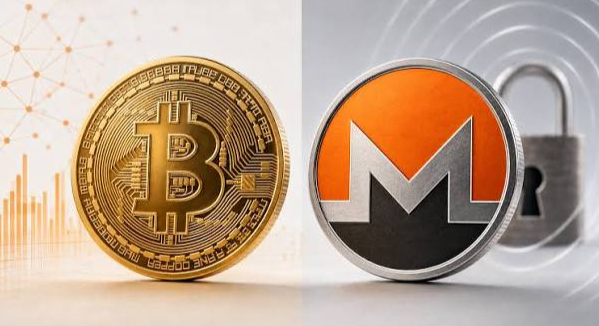
You send someone Bitcoin. They get it. And somewhere between those two events, anyone on earth with an internet connection can watch it happen – the address it left, the address it arrived at, the exact amount, the timestamp. That info is on a public ledger and stays there permanently. Not for a few years, though. For good.
That's not a flaw in Bitcoin. That's just how it was designed.
Monero starts from the opposite end of that question. When you send XMR, the sender and recipient are both hidden — it's not something you can just switch on or pay extra for, it's just how Monero transactions work.
Understanding why someone would convert BTC to XMR starts with understanding what that difference actually does in practice.
How Bitcoin's public ledger works in practice
When you broadcast a Bitcoin transaction, you're basically sending a message to the whole network saying that address A spent this output and address B received it. So, miners put that message into a block, which gets added to the chain and stays there permanently. So, basically, every wallet, every transaction, every satoshi – you can ask about all of it, forever.
The word "pseudonymous" is used a lot here, and it's technically accurate. Just so you know, your wallet address isn't your name. But using a pseudonym only works until something connects the address to a real identity. That could be an exchange account where you bought the BTC, a tax filing, a forum post where you shared your address for donations, or a payment to a merchant who knows who you are. Once that link exists, chain analytics tools can trace every transaction that wallet ever touched — in both directions, across its entire history, all the way back to the first one.
This isn't just some theoretical idea. There are a few companies — Chainalysis, Elliptic, TRM Labs — that do this for a living, selling the data to exchanges, compliance teams and law enforcement. Some platforms run incoming deposits through these screening services and flag coins that have been linked to sanctioned addresses or illicit activity. The idea is called "taint": coins that passed through a dodgy wallet at any point in their history carry a mark that follows them forever, even to owners who've got nothing to do with the original transaction. If you got BTC in 2019 for a job you did, and it was tainted, you might still see it on an exchange in 2026.
How Monero hides all three: sender, recipient, amount
Monero uses four cryptographic mechanisms working together, with each one handling a different part of the transaction.
Ring signatures are for the sender. When you spend XMR, your real spending input is mixed with fifteen other inputs drawn from past transactions on the chain. An outside observer can see that one of those sixteen inputs authorised the transaction — but not which one. The ring size increased from 11 to 16 in a hard fork in August 2024, expanding the anonymity set with each upgrade.
So, what these addresses do is handle the recipient. Whenever someone sends you XMR, Monero generates a one-time address for that payment. The blockchain doesn't link multiple payments to the same wallet. You can publish your Monero address publicly and observers still won't be able to tell what's been sent to it, when, or how often.
RingCT (Ring Confidential Transactions) handles the amount. This layer uses cryptographic commitments — the maths lets validators confirm that a transaction balances (inputs equal outputs, no coins created from nothing) without revealing the actual numbers involved. A 2022 upgrade called Bulletproofs+ reduced the computational overhead of these range proofs by 96%, making transactions faster and cheaper without changing what they conceal.
Dandelion++ handles network-level surveillance. When a transaction is first broadcast, it goes through a randomised chain of relay nodes before spreading to the full network. This makes it a lot harder to work out where the transaction came from, which is important for anyone worried about network monitoring as well as on-chain analysis.
We're also working on a fifth mechanism right now. We're expecting Full Chain Membership Proofs (FCMP++), which is due to be deployed in 2026. It replaces ring signatures with zero-knowledge proofs over the whole blockchain. Instead of the usual sixteen outputs, every single one becomes part of it. That's a big step up: ring signatures with sixteen decoys are solid, but a big enough sample of transactions can still narrow probabilities over time. FCMP++ gets rid of that risk.
Monero uses four cryptographic mechanisms working together, with each one handling a different part of the transaction. Ring signatures are for the sender. When you spend XMR, your real spending input is mixed with fifteen other inputs drawn from past transactions on the chain. An outside observer can see that one of those sixteen inputs authorised the transaction — but not which one. The ring size increased from 11 to 16 in a hard fork in August 2024, expanding the anonymity set with each upgra
Monero uses four cryptographic mechanisms working together, with each one handling a different part of the transaction.
Ring signatures are for the sender. When you spend XMR, your real spending input is mixed with fifteen other inputs drawn from past transactions on the chain. An outside observer can see that one of those sixteen inputs authorised the transaction — but not which one. The ring size increased from 11 to 16 in a hard fork in August 2024, expanding the anonymity set with each upgrade.
So, what these addresses do is handle the recipient. Whenever someone sends you XMR, Monero generates a one-time address for that payment. The blockchain doesn't link multiple payments to the same wallet. You can publish your Monero address publicly and observers still won't be able to tell what's been sent to it, when, or how often.
RingCT (Ring Confidential Transactions) handles the amount. This layer uses cryptographic commitments — the maths lets validators confirm that a transaction balances (inputs equal outputs, no coins created from nothing) without revealing the actual numbers involved. A 2022 upgrade called Bulletproofs+ reduced the computational overhead of these range proofs by 96%, making transactions faster and cheaper without changing what they conceal.
Dandelion++ handles network-level surveillance. When a transaction is first broadcast, it goes through a randomised chain of relay nodes before spreading to the full network. This makes it a lot harder to work out where the transaction came from, which is important for anyone worried about network monitoring as well as on-chain analysis.
We're also working on a fifth mechanism right now. We're expecting Full Chain Membership Proofs (FCMP++), which is due to be deployed in 2026. It replaces ring signatures with zero-knowledge proofs over the whole blockchain. Instead of the usual sixteen outputs, every single one becomes part of it. That's a big step up: ring signatures with sixteen decoys are solid, but a big enough sample of transactions can still narrow probabilities over time. FCMP++ gets rid of that risk.
The regulatory fallout: who delisted XMR and when
The same features that make Monero valuable for privacy are also what make it difficult for regulated exchanges to support. Standard AML compliance frameworks require exchanges to keep an eye on transactions, spot any dodgy activity, and sometimes report on specific users in certain places. You can't do any of that with XMR — the transaction data that compliance tools rely on just isn't there.
Binance removed all four XMR trading pairs — BTC/XMR, ETH/XMR, USDT/XMR, BNB/XMR — all at once on 20 February 2024. There won't be any advance announcement or wind-down period for active positions. OKX had already gone in January. Huobi two years earlier. Kraken stopped XMR for clients in the European Economic Area in October 2024 because of regulatory pressure from EEA financial authorities, but it's still available in other places.
Most of the remaining services are non-custodial swap services, and there are a few offshore platforms operating outside the major AML compliance frameworks. That's a whole other level of infrastructure: smaller liquidity pools, wider rate variation across platforms, and some individual swap partners who apply enhanced KYC specifically for XMR transactions even when the platform itself doesn't require general registration. If a swap service shows offers from different liquidity sources, it's worth checking the KYC label on each before committing — some require identity verification for XMR regardless of amount, others don't.
What to expect when you swap: timing and practicalities
A BTC-to-XMR swap goes through two confirmation windows, one after the other.
With Bitcoin, most swap partners start processing after one to three confirmations. It takes about ten minutes to confirm a Bitcoin at normal network speed, so budget ten to thirty minutes for this phase. If the Bitcoin network is congested and you set a low fee, your transaction might end up waiting in the queue before it's even included in a block. So, setting a medium or higher fee when you send your transaction should stop this from happening.
With Monero, incoming funds need ten confirmations before they can be spent. It takes about two minutes for Monero's blocks to be confirmed, so it'll be around twenty minutes from the time the exchange sends the XMR until your wallet can use it. The total time taken is usually between thirty and sixty minutes, with Bitcoin confirmations being the main thing to consider.
Two things that first-time Monero recipients should be aware of. A standard Monero address is made up of 95 characters, and it always starts with the number 4. Subaddresses – the go-to format in most modern wallets – are also 95 characters, but they start with 8. Both formats get the money right, but the address has to belong to a Monero wallet. No other network uses that format, and funds sent to the wrong address can't be recovered.
Unlike some other assets, Monero doesn't use memo fields or destination tags. The stealth address system automatically assigns each payment its own unique on-chain address, so the payment is identifiable to the recipient's wallet without any additional identifiers.
The rate question: why XMR pricing works differently
XMR liquidity is not as strong as Bitcoin's, and that has a direct effect on swap pricing. If you're on a platform with plenty of BTC liquidity, you won't have to worry too much about slippage when you're trading small amounts. With XMR, there's less liquidity spread across fewer platforms, so the gap between buy and sell prices is usually wider. Plus, larger swaps have a bigger impact on the executed rate.
Fixed-rate swaps are more important here than they are for standard Bitcoin pairs. The rate locked at order creation is guaranteed, no matter what happens during the ten to thirty minutes it takes for the Bitcoin network to confirm the deposit. Because of XMR's price spreads, which can be pretty volatile, there can be a big difference between the quoted rate and the market rate when it's executed.
It only takes two or three minutes to check a couple of platforms before confirming, and sometimes the numbers are really different – especially with XMR compared to more liquid pairs.
What this choice is actually about
Bitcoin and Monero aren't competing for the same thing. They answer different questions.
Bitcoin asks: how do you build a decentralised monetary system that anyone can audit? The public ledger is a feature, not a concession — it's what lets anyone verify the total supply, trace where coins came from, and confirm that no inflation happened without permission. This is the basis of Bitcoin's trustless model.
So, Monero's got this question: how can we make digital cash that works like real money, where everyone involved in a transaction knows what's going on and no one else does? If person A pays person B in cash, this isn't on the public record. No one can audit your wallet's history, and the fact that you once received a £50 note that previously passed through a gambling house doesn't make your current £50 tainted.
Both questions are fair enough. The person choosing between them is deciding what they want their financial activity to look like from the outside. With Bitcoin, that decision is recorded in the public ledger. With Monero, it's the people involved in the transaction that get the money.


